KinopiQ

Impact and accreditation tracking

Know what the standard actually asks of you

A modern standard is not a checklist — what you owe depends on your size, your sector and where you are in the cycle. KinopiQ works that out first, then gives you one place to record answers, attach evidence, and see a score you can put in front of a board.

B Corp · ISO 14001 · GRI · IFRS S1 & S2 · UK SRS

B Corp · V2.1 · one organisation

35 of 48 requirements apply

Applies to youOut of scope — not counted against you
Illustrative. What applies depends on your worker count, revenue, sector, certification phase and risk flags.

How it works

Scope first, then proof

  1. 01

    Describe your organisation

    Worker count, revenue, sector, and where you are in the certification cycle. It takes a few minutes and it is the only thing standing between you and a correct denominator.

  2. 02

    Work the requirements that apply

    KinopiQ resolves your applicable set and hides the rest. Record an answer against each one, attach the documents that prove it, and give it an owner.

  3. 03

    See where you actually stand

    A score computed from what you owe, with unmet mandatory requirements listed separately as blockers. Invite an assessor as a viewer when you are ready.

What applies to you

A five-person consultancy does not owe what a 5,000-person manufacturer owes

B Lab’s V2.1 standards gate nearly every sub-requirement on company size, sector and certification phase. KinopiQ models that directly: it derives your size band from your worker count and your revenue, takes whichever gives the smaller band, and resolves the requirements you actually owe.

  • Seven size bands, five sectors, three certification phases
  • Risk flags trigger requirements that size alone would not
  • Out-of-scope requirements are hidden, not marked as gaps

How scope is resolved

Progress · applicable set

61%

Met
61%
In progress
18%
Not started
21%
2 blocking

Two mandatory requirements are unmet. Counted separately, because 61% with a mandatory gap is not 61% of the way to certified.

Illustrative figures. Scores are computed from the requirements that apply to you; requirements marked not-applicable leave the denominator entirely.

Evidence and proof

Attach a document once, prove several things with it

One employee handbook can be evidence for a fair work requirement, an inclusion requirement and a human rights requirement at the same time. KinopiQ links documents to requirements many-to-many, so you upload it once and it counts everywhere it should.

  • Every requirement shows how much evidence stands behind it
  • Documents are held privately and reached by short-lived signed links
  • Give your assessor a viewer seat — they read everything, change nothing

How evidence works

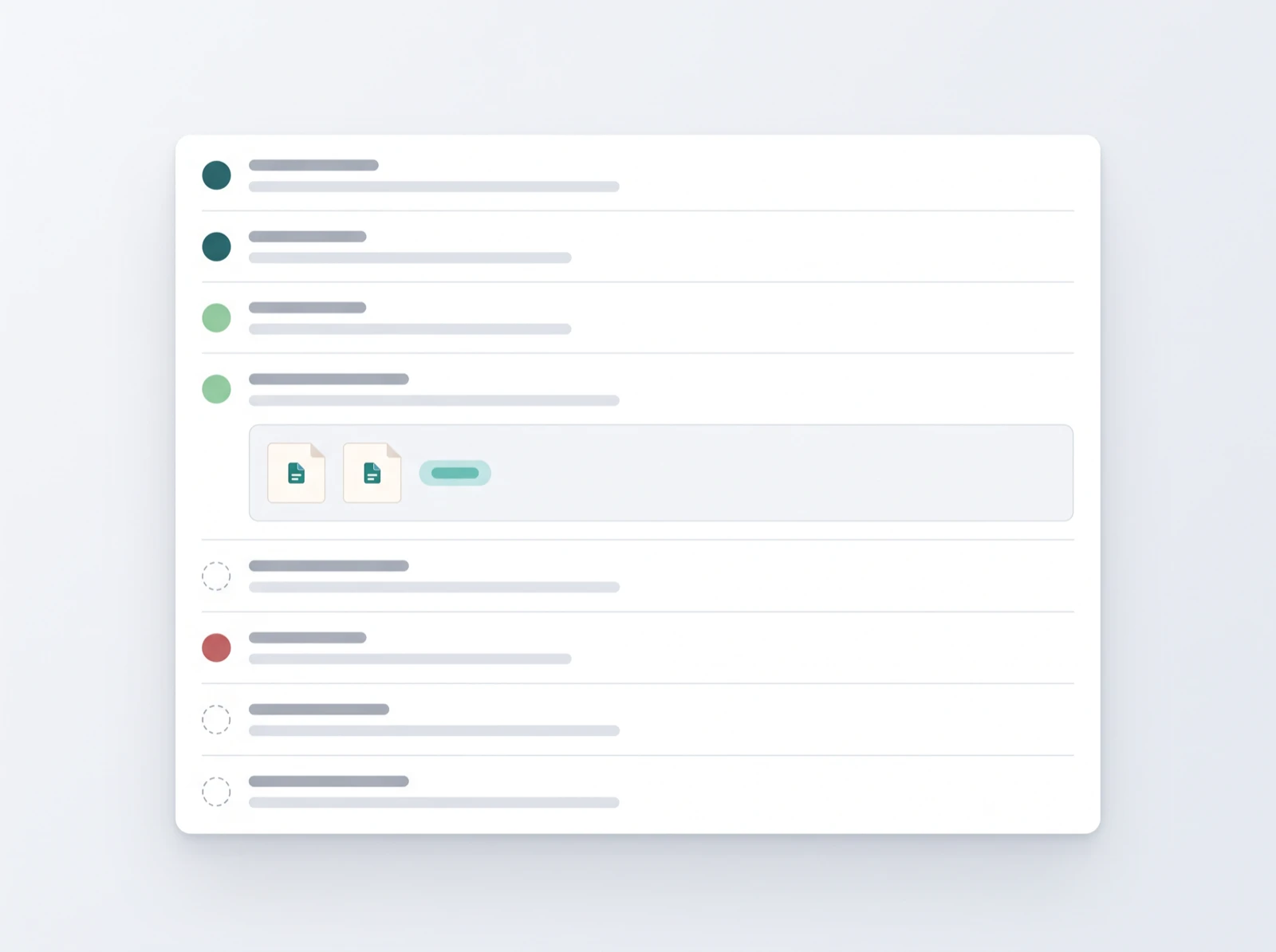
A requirement and its linked evidence in the KinopiQ app

Built to be defensible

The parts that decide whether you can trust the number

Anyone can draw a progress bar. These are the rules underneath it.

A score you can defend

Every percentage is worked out on the server from the applicable set. Only leaf requirements count, so nesting never inflates the total, and marking something not-applicable — with a reason — raises your score instead of depressing it.

Blockers kept separate

Unmet mandatory requirements are reported on their own, apart from the headline figure. Ninety-five per cent with one mandatory gap is not ninety-five per cent of the way to certified, and KinopiQ will not let a progress bar imply otherwise.

Standards that stay current

Six frameworks, each carrying its own edition, effective date and lifecycle. When an edition is superseded — as ISO 14001:2015 was, and TCFD before it — the app says so and names the transition deadline rather than going quietly stale.

The whole team, one record

Invite colleagues into a workspace by email as editors or viewers, and give each requirement an owner. Your auditor or certification body gets read access without being able to change the answers.

FAQ

Frequently asked

What KinopiQ does, how the scoring works, and what it deliberately leaves to someone else.

What is KinopiQ?
KinopiQ is a web app that tracks an organisation’s progress toward accreditation and sustainability-reporting standards — B Corp, ISO 14001, GRI, IFRS S1 & S2, UK SRS S1 & S2 and TCFD. You describe your organisation once (worker count, revenue, sector and where you are in the certification cycle), and KinopiQ works out which requirements genuinely apply to a company of that shape. You then record an answer against each one, attach the documents that prove it, and see a completion score computed from the requirements you actually owe. KinopiQ is built by AKdev and is currently in development.
Which standards and frameworks does KinopiQ support?
Six: B Corp (B Lab Standards V2.1), ISO 14001:2026, GRI (Universal Standards 2021 with topic standards through 2025, including GRI 101 Biodiversity 2024 and GRI 102 Climate Change and 103 Energy 2025), IFRS S1 & S2 (the ISSB global baseline), UK SRS S1 & S2 (published February 2026), and TCFD (2017). TCFD is included but marked superseded — the task force disbanded in October 2023 and its recommendations are now carried by IFRS S2 — because reporting regimes still reference it by name. Each framework in KinopiQ carries its own edition, effective date and transition deadline, so a standard that has moved on says so rather than going quietly stale.
How is KinopiQ different from B Lab’s own B Impact Assessment, or a spreadsheet?
B Lab’s B Impact Assessment covers B Corp only, and it is the system of record for that certification — KinopiQ does not replace it or submit on your behalf. The difference is scope resolution and reuse across standards. B Lab’s V2.1 standards gate nearly every sub-requirement on company size, sector and certification phase, so two organisations working to the same standard owe genuinely different things; KinopiQ resolves that for you and measures your score against your applicable set rather than the whole standard. Against a spreadsheet, the difference is that the requirements are maintained reference data with editions and effective dates, evidence attaches to requirements rather than living in a shared drive, and the score is computed on the server under fixed rules instead of by formulas someone has to keep correct. If you only ever need B Corp and you are comfortable working directly in B Lab’s tool, you may not need KinopiQ at all.
How does KinopiQ decide which requirements apply to my organisation?
From four things you record in your company profile: full-time-equivalent worker count, annual revenue, sector, and any risk flags from B Lab’s risk-profiling step. Worker count and revenue each map to one of seven size bands, and B Lab’s rule is that you sit in whichever of the two gives the smaller band — so a five-person consultancy turning over £80m is not asked to do what a 5,000-person manufacturer does. Sector is one of five. Certification phase (Year 0 to certify, Year 3 and Year 5 to recertify) is cumulative, so a company at Year 5 still owes everything from Year 0. A requirement whose envelope does not match is hidden entirely rather than shown as an unmet gap.
How is the completion score calculated?
As the proportion of the requirements that apply to you which you have marked met. Three rules decide every figure. Only leaf requirements count, because standards nest and a parent code is a heading rather than a separate obligation — counting both would inflate the total. Only requirements applicable to your size, sector, phase and risk profile are in the denominator. And marking a requirement not-applicable, which needs a written reason, removes it from both sides of the fraction, so it raises your percentage rather than depressing it. Unmet mandatory requirements are reported separately as blockers and are never folded into the headline figure, because 95% with one mandatory gap is not 95% of the way to certified.
What data does KinopiQ store?
Your company profile (worker count, annual revenue and its currency, sector, risk flags and the size band derived from them), your answer against each requirement including any written notes and the person accountable for it, the documents you upload as evidence and which requirements each one is linked to, and your workspace’s membership and roles. Evidence documents are held in a private store and reached only through short-lived signed links; the browser never talks to the storage backend directly. Access is enforced in the database by row-level security keyed on workspace membership, not just in the interface. KinopiQ is published by AKdev Ltd, and AKdev’s Privacy Policy governs how that data is handled.
Can I invite colleagues, an assessor or an auditor?
Yes. A workspace has one owner and any number of invited collaborators, each an editor or a viewer. Editors can change answers, evidence and the company profile; viewers can read everything but change nothing, which is the role to use for an assessor, an auditor or a board member who needs to see the working without editing it. Only the owner can invite people, change someone’s role or remove them. You can also record an owner against each individual requirement so it is clear who is accountable for it.
Does KinopiQ certify my organisation, or submit my application?
No. KinopiQ is a preparation and record-keeping tool, not a certification body and not a submission channel. Certification decisions are made by the relevant body — B Lab for B Corp, an accredited certification body for ISO 14001 — and you submit to them through their own processes. What KinopiQ gives you is a defensible picture of where you stand before you apply: which requirements apply to you, which are met, what evidence supports each one, and what is still blocking you.
What does KinopiQ run on?
It is a web app that runs in any modern browser, with no software to install. There is no iOS or Android app. KinopiQ is in development, so features and availability are still changing.

In development

Find out where you actually stand

KinopiQ is in development and early access is by arrangement. Tell us which standard you are working toward and we will get you set up.